
Though private hospitals with amenities that are more similar than a luxury 5-star hotel than a hospital usually steal the spotlight, Bangkok is home to many government hospitals that provide amazing medical care and value for the money.
These public institutions train the doctors who later work at Thailand's top private hospitals, and several rank among the best in the country according to hospital rankings made by independent institutions.
Let's walk through the differences between government and private hospital and then list the top government hospitals in Bangkok, showing you where you can get excellent care at a fraction of the cost of private facilities.
Best Public Hospitals in Bangkok
The following rankings are informed by Newsweek's World's Best Hospitals 2025, which evaluates hospitals based on surveys of medical experts, patient satisfaction data, and quality metrics and our own experience as the leading medical tourism agency in Thailand which supports thousands of foreigners in seeking healthcare in Thailand each year.
1. Siriraj Piyamaharajkarun Hospital

Siriraj Hospital is Thailand's oldest and largest public hospital. Founded in 1888 by King Chulalongkorn, it sits on the banks of the Chao Phraya River and serves as the primary teaching hospital for Mahidol University's Faculty of Medicine.
With over 2,200 beds and more than 3 million outpatients annually, Siriraj is a national referral center for complex and rare diseases. The hospital's 61 specialty clinics cover virtually every medical discipline. As a major teaching institution, it trains many of the doctors who go on to work at Thailand's top private hospitals.
The hospital is renowned for its comprehensive oncology center, cardiovascular surgery, neurosurgery, and organ transplant programs. Siriraj has been entrusted with the care of members of the Royal Family, including the late King Bhumibol Adulyadej, who resided there from 2009 until his passing in 2016.
Note: Siriraj Piyamaharajkarun Hospital (SiPH) is a separate 345-bed premium facility that opened in 2012 within the Siriraj complex. While SiPH holds JCI accreditation and offers private hospital-level service, it operates with private hospital pricing. The main Siriraj Hospital described here is the government-funded facility.
- Over 2,200 beds with 61 specialty clinics
- Thailand's oldest hospital (founded 1888)
- National referral center for complex and rare diseases
- Located on the Chao Phraya River; easiest to reach by taxi, Grab, or the Siriraj Pier ferry. No direct BTS or MRT station
2. King Chulalongkorn Memorial Hospital

King Chulalongkorn Memorial Hospital is affiliated to Thailand's top-ranked Chulalongkorn University and is situated in the heart of the city, right next to Lumphini park.
Since its founding in 1914, it has grown into a major medical complex with 1,435 beds. The hospital's affiliation with the Thai Red Cross Society and Chulalongkorn University's Faculty of Medicine means many of Thailand's healthcare professionals graduate and train here before progressing to the country's top private hospitals.
Chulalongkorn is renowned for its comprehensive cancer center, cardiology department, and advanced transplant unit. It has been the choice of various Thai dignitaries, reflecting its status as a trusted healthcare provider. Its medical staff includes some of the nation's most respected clinicians and surgeons, many of whom have been recognized with national and international awards.
- 1,435 beds with multiple centers of excellence
- Affiliated with Thai Red Cross Society and Chulalongkorn University
- Ranked #4 in Thailand by Newsweek 2025 (score: 83.60%)
- Located next to Lumphini Park, easily accessible by MRT (Si Lom station) and BTS (Sala Daeng station)
3. Ramathibodi Hospital

Ramathibodi Hospital, also known as the Faculty of Medicine Ramathibodi Hospital, is a university hospital of Mahidol University. It serves as one of Thailand's most important referral centers for rare and complicated diseases.
Located near Victory Monument and the former Chitralada Palace grounds, Ramathibodi opened in 1969 and has expanded to include over 1,300 beds. The hospital handles approximately 5,000 outpatients daily across its various departments.
The hospital is recognized for its outstanding departments of neurology, nephrology, pediatrics, and oncology. It has received numerous accolades for clinical and research excellence
- Over 1,300 beds across main building and SDMC
- Ranked #7 in Thailand by Newsweek 2025 (score: 80.63%)
- Final referral center for rare and complicated diseases
- Near Victory Monument; accessible by BTS (Victory Monument station) and bus routes
4. Rajavithi Hospital

Rajavithi Hospital offers comprehensive medical services to both local and international patients. Founded in 1951 as the Women's Hospital, it has evolved into a multi-specialty facility and is now the largest hospital in Thailand's Ministry of Public Health system. With a capacity of 1,200 inpatient beds, Rajavithi Hospital treats up to 1 million outpatients annually.
Rajavithi Hospital is known for its expertise in cardiology, neurology, and oncology, with a team of highly qualified and experienced specialists. The hospital has seven Centers of Excellence that provide specialized care in areas such as ENT (Ear, Nose, and Throat), trauma, and head and neck cancer. It serves as a major organ transplant facility and operates a large trauma unit
The hospital is easily accessible via taxis, buses, and the BTS Skytrain Rajavithi Hospital is a teaching hospital for the College of Medicine, Rangsit University hasreceived accreditations and awards for its medical services and commitment to healthcare excellence.
5. Vajira Hospital
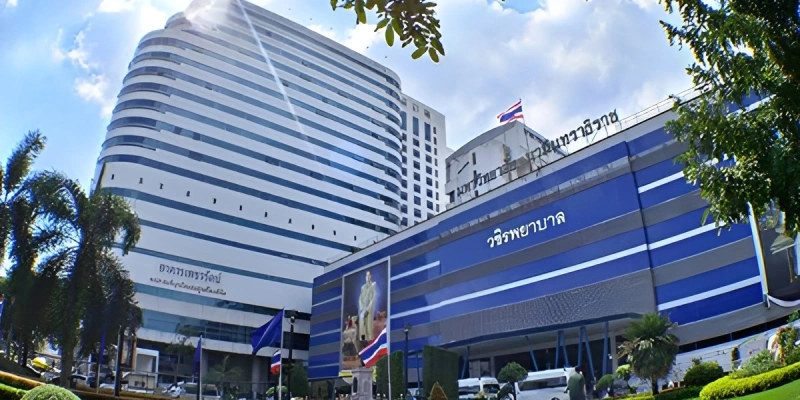
Vajira Hospital is one of Thailand's oldest hospitals, founded in 1913 by King Rama VI. It is funded and operated by the Bangkok Metropolitan Administration (BMA) and serves as a teaching hospital for Navamindradhiraj University and Srinakharinwirot University.
With 900 beds, Vajira is the largest hospital operated by the BMA. The hospital handles approximately 700,000 outpatient visits and 30,000 inpatient admissions annually. In 1923, Prince Mahidol, the father of Thai modern medicine, was appointed director of the hospital.
Vajira has Centers of Excellence in cardiovascular care, oncology, neurosurgery, kidney disease and transplantation, and trauma. Its Trauma Centre is considered one of the finest emergency facilities in Bangkok, making it a key part of the city's emergency response network.
Note: In September 2025, a large sinkhole formed on Samsen Road in front of Vajira Hospital due to MRT Purple Line construction, temporarily affecting access.
- 900 beds with multiple Centers of Excellence
- Ranked #17 in Thailand by Newsweek 2025 (score: 71.91%)
- Largest hospital operated by the Bangkok Metropolitan Administration
- Strong focus on urban medicine and emergency services
- Located in Dusit District near the Chao Phraya River
6. Phramongkutklao Hospital
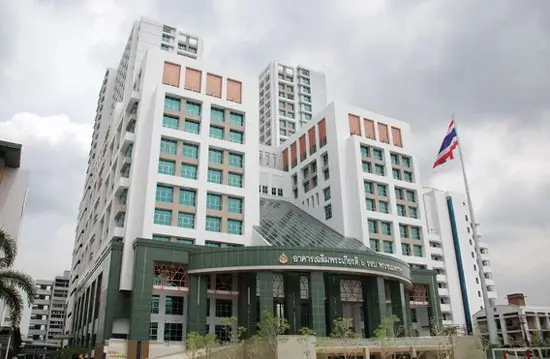
Phramongkutklao Hospital is a military hospital for the Royal Thai Army that also serves the general public. Founded in 1932 at the former Phaya Thai Palace, it is a teaching hospital for Phramongkutklao College of Medicine.
The hospital has 1,200 beds and offers comprehensive medical services across multiple specialties. It has Centers of Excellence in cancer, trauma, the Sirindhorn Heart Centre, organ transplantation, and military medicine.
As a military hospital, Phramongkutklao has particular expertise in trauma care and rehabilitation. The hospital is actively involved in medical research and maintains high standards for patient care and safety. While primarily serving military personnel, it welcomes civilian patients and offers competitive pricing.
- 1,200 beds with five Centers of Excellence
- Ranked #25 in Thailand by Newsweek 2025 (score: 71.50%)
- Teaching hospital for Royal Thai Armed Forces medical education
- Strong expertise in trauma care and rehabilitation
- Located in Ratchathewi District; centrally located in Bangkok
7. Police General Hospital
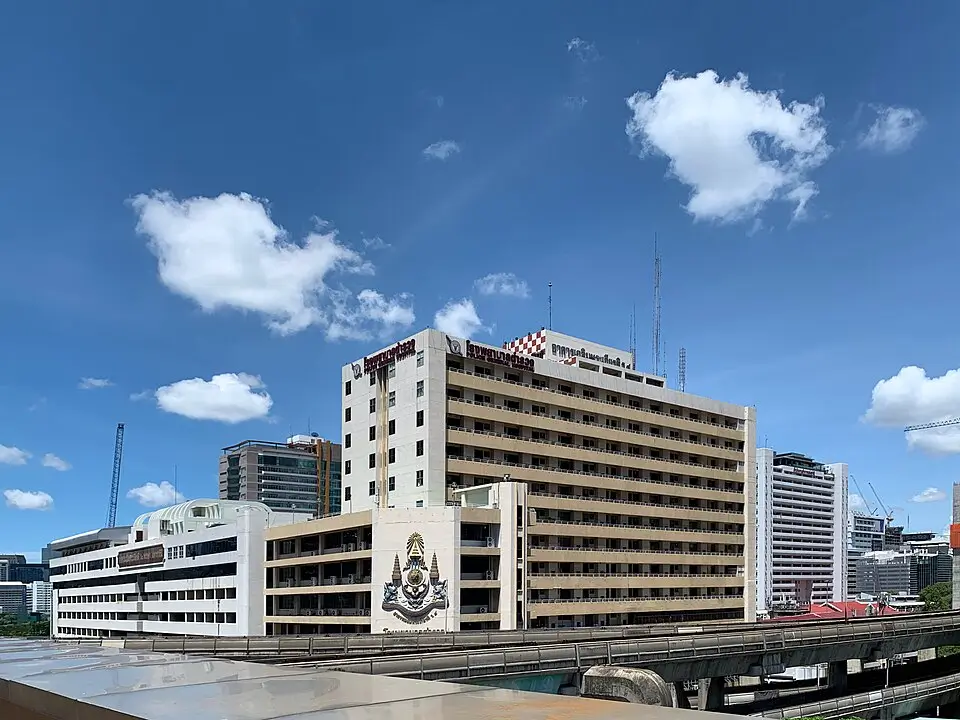
Police General Hospital, founded in 1897, serves both the Royal Thai Police and the general public. Located in Pathum Wan District near Siam, it is one of the most centrally located government hospitals in Bangkok.
With approximately 700-900 beds, Police General Hospital operates as a teaching hospital affiliated with Srinakharinwirot University and the Royal Thai Police Nursing College. The hospital offers comprehensive medical services including surgery, orthopedics, pediatrics, obstetrics and gynecology, neurology, and cardiology.
Its central location near major shopping districts and the BTS Skytrain makes it one of the most accessible government hospitals for foreigners and tourists. The hospital is actively involved in medical research and continuing medical education programs.
- 700-900 beds with comprehensive medical services
- Teaching hospital for Srinakharinwirot University
- Located near Siam in Pathum Wan District, one of the most central locations
- Easily accessible via BTS (National Stadium station)
8. Thammasat University Hospital

Thammasat University Hospital is a leading tertiary-level facility located on Thammasat University's Rangsit campus in Pathum Thani Province, north of Bangkok. With over 30 years of history, it has evolved into a premier public teaching hospital.
The hospital has 889 beds and treats 4,000-5,000 outpatients daily. It serves as a teaching hospital for Thammasat University's faculties of Medicine, Nursing, Dentistry, Allied Health Science, and Public Health.
In June 2024, the new Thammasat Advanced Medical Center (THAMC) building began services. This 10-story, 53,965 square meter facility offers premium medical services and is designed with sustainability features. THAMC provides services at approximately 30% lower cost than comparable private hospital facilities like Siriraj Piyamaharajkarun.
Thammasat focuses on advanced technology in complex disease treatment and emphasizes minimally invasive surgery and endoscopic procedures to reduce post-operative pain and hospital stays.
- 889 beds with new THAMC premium facility
- Teaching hospital for multiple Thammasat University faculties
- New THAMC building opened June 2024 with modern amenities
- Located in Pathum Thani Province (north of Bangkok), approximately 40 minutes from central Bangkok
What should foreigners know before visiting a government hospital?
Government hospitals tend to have longer wait times and more basic amenities, but they offer competent care at a lower price and are accessible across the city. While Private hospitals in Bangkok offer a more luxurious experience with state-of-the-art facilities and shorter wait times, they also come with a higher price tag.
- Wait times: Government hospitals operate largely on a first-come-first-served basis. Patients often wait several hours for consultations, and surgery appointments can be months out. If you're planning to visit, arrive as early as 6am to get a queue ticket for faster service.
- English-speaking staff: English proficiency varies significantly between hospitals. Although doctors will often be able to communicate in English, nurses and administrative staff usually have limited English proficiency. Bringing a Thai-speaking friend or using a translation app is often helpful at government hospitals.
- Dual pricing for foreigners: Since 2019, Thai public hospitals follow a tiered pricing system for foreigners based on visa status:
- Tier 1: Thai nationals (lowest fees)
- Tier 2: Foreigners from neighboring countries (like Laos, Myanmar, etc.)
- Tier 3: Working foreigners with non-immigrant visas
- Tier 4: Tourists and retirees (highest fees)
- Premium clinics within government hospitals: Many government hospitals now offer "premium" or "special" clinics within their facilities. These provide faster service, private rooms, and better amenities for higher fees. They're still more affordable than private hospitals while offering improved comfort for foreigners unfamiliar with the standard government hospital experience.
Conclusion
The government hospitals listed above offer affordable alternatives to Bangkok's premium private facilities. While they may not have all the modern amenities that private hospitals provide, they deliver reliable care at a fraction of the cost. Many of these institutions train the doctors who later staff Thailand's top private hospitals.
When choosing between government and private hospitals, consider your priorities:
- Choose government hospitals if: Budget is important, you're flexible with time, you can navigate with basic Thai or have translation support, and you don't require private hospital-level amenities.
- Choose private hospitals if: You want faster service, guaranteed English-speaking staff, premium amenities, and are willing to pay higher prices.
For foreigners unfamiliar with navigating Thailand's healthcare system, consider using the premium clinics available within many government hospitals. They offer a middle ground between standard government services and private hospital pricing.





.svg)

.png)


